ECDF vs GUE — per-run panels
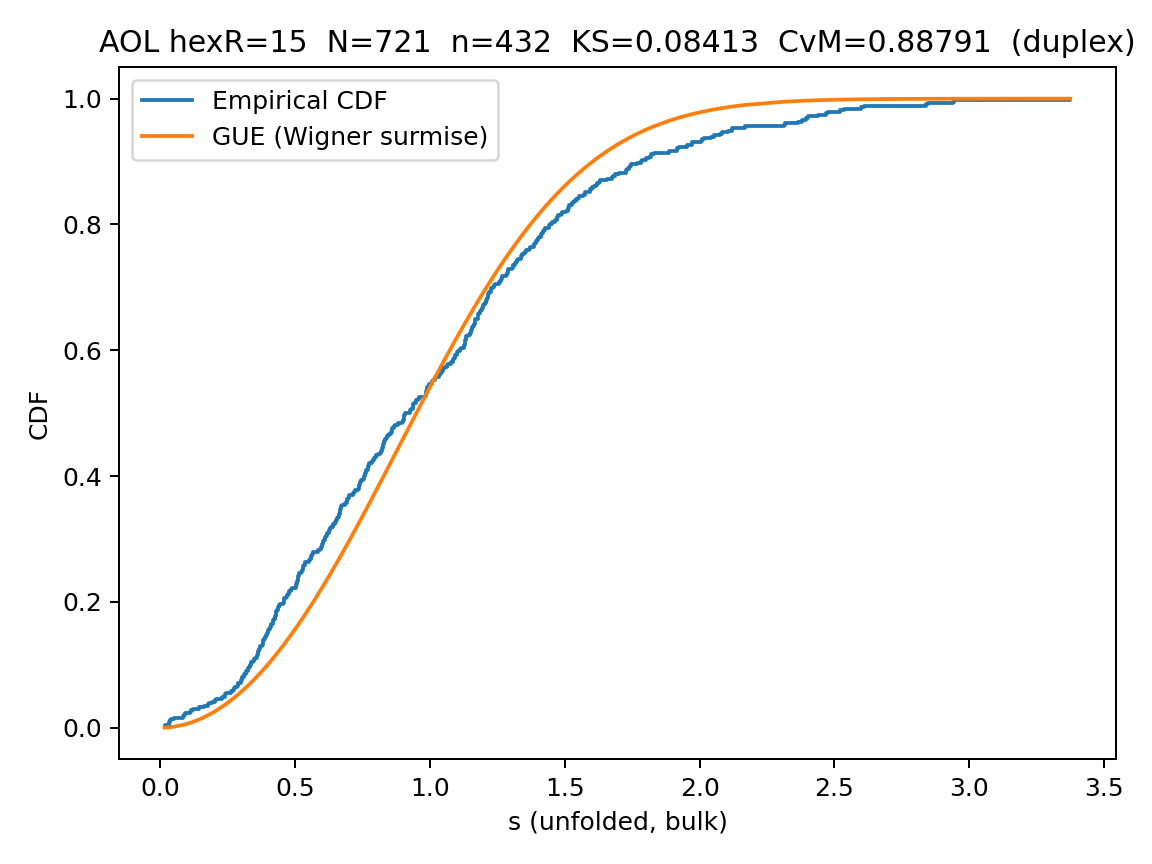
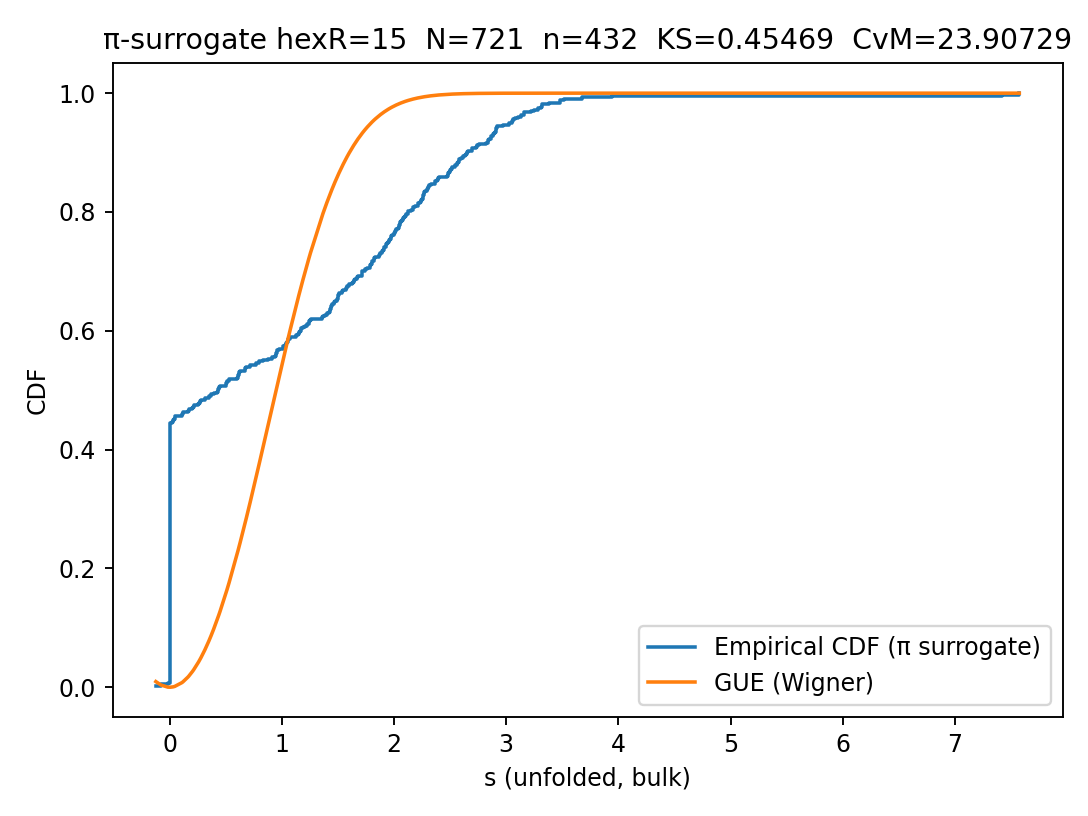
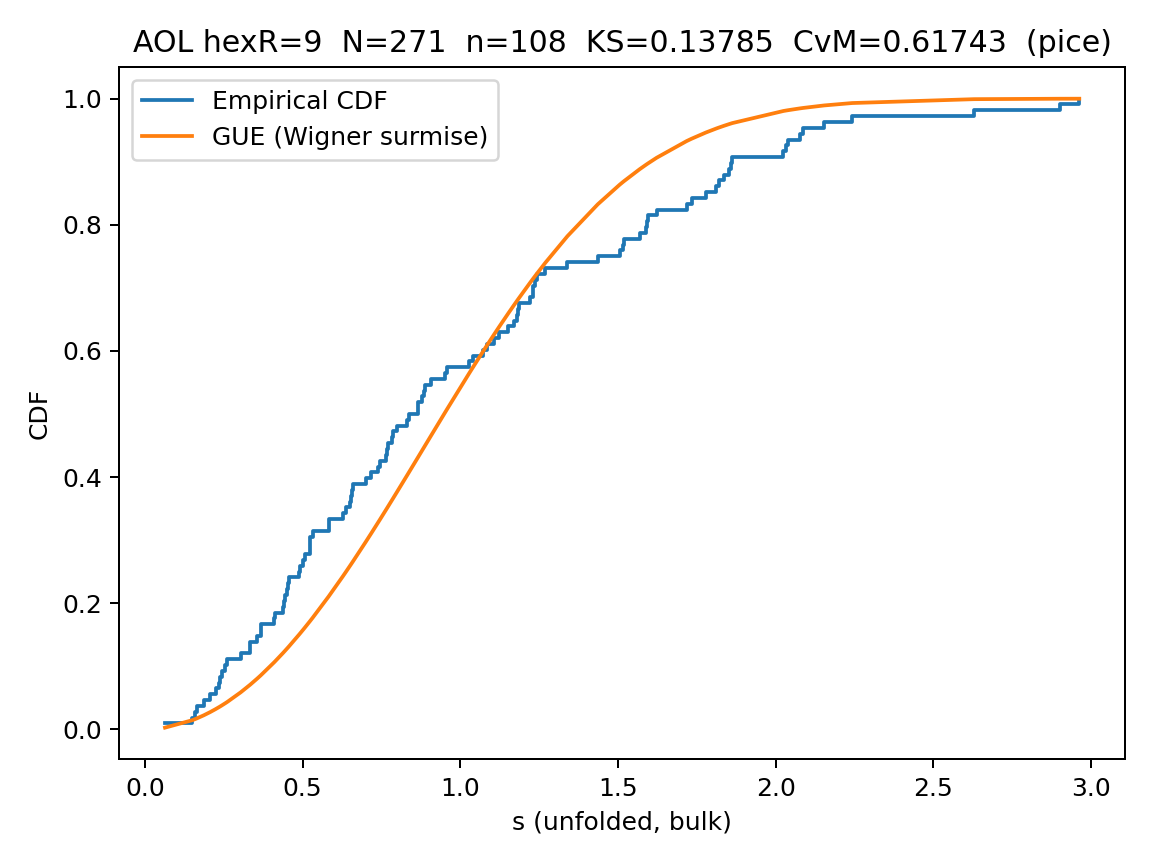
Click any panel to open the full-size image in a new tab.
Numerical results
| Run | Anchoring | R | N | Bulk | KS | CvM | Interpretation |
|---|---|---|---|---|---|---|---|
| R9-PICE | PICE (half-amplitude curvature) | 9 | 271 | 0.30–0.70 | 0.138 | 0.617 | Curvature equilibrium forming |
| R15-Duplex (Λ) | von Mangoldt anchored | 15 | 721 | 0.20–0.80 | 0.084 | 0.888 | GUE match, prime-lock coherence |
| R15-π Surrogate | Constant π (control) | 15 | 721 | 0.20–0.80 | 0.455 | 23.9 | No GUE, coherence lost |
Figures (click to open full-size)
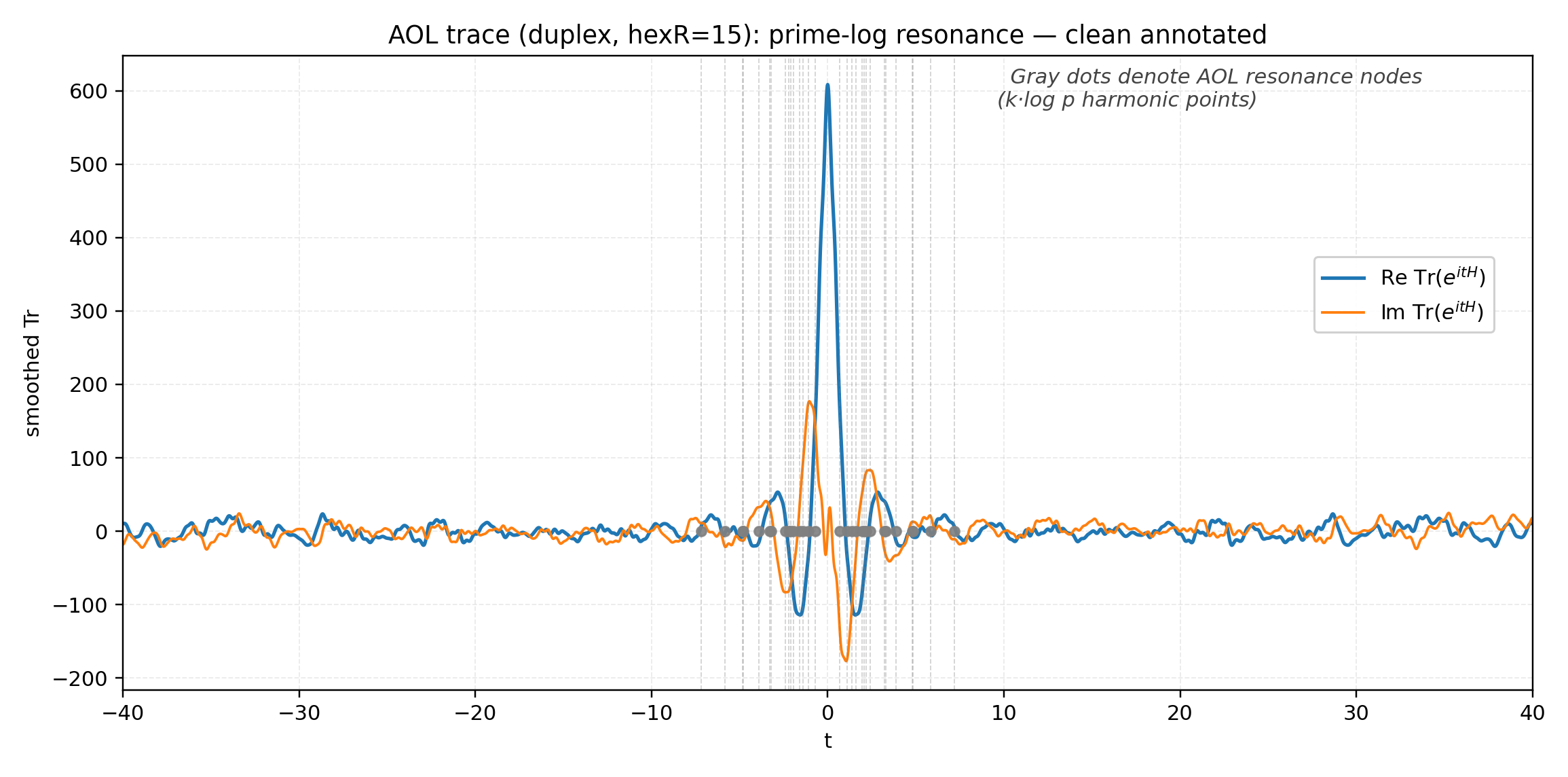
All images are high-resolution; open in a new tab to inspect peak structure and overlays.
Raw datasets (JSON & CSV)
- Λ-anchored (Duplex), hexR=15, bulk 0.20–0.80
- run_R15_duplex_bulk020-080.json (params + stats)
- spacings_R15_duplex_bulk020-080.csv (unfolded bulk spacings)
- π-only surrogate (control), hexR=15, bulk 0.20–0.80
- PICE variant, hexR=9, bulk 0.30–0.70
Analytical Programme (remaining tasks)
We isolate the two remaining objectives required to complete the operator framework.
1) Explicit-Formula Trace (EF)
Prove that for a dense class of even Schwartz test functions \( \varphi \in \mathcal{S}_{\mathrm{even}}(\mathbb{R}) \), the trace identity holds:
\[ \operatorname{Tr}\,\varphi(H) = \mathcal{M}_{\varphi} + \sum_{p}\sum_{k\ge 1} \frac{\Lambda(p^{k})}{p^{k/2}} \bigl(\varphi(k\log p)+\varphi(-k\log p)\bigr) \tag{EF} \]Since \( \varphi \) is even, this is equivalently
\[ \operatorname{Tr}\,\varphi(H) = \mathcal{M}_{\varphi} + 2\sum_{p}\sum_{k\ge 1} \frac{\Lambda(p^{k})}{p^{k/2}}\,\varphi(k\log p). \tag{EF'} \]Here \( \mathcal{M}_{\varphi} \) denotes the archimedean / conductor contribution (as defined elsewhere on this page).
2) Critical-Line Spectrum (CRIT)
Identify the spectrum of \(H\) with the critical-line ordinates:
\[ \operatorname{spec}(H)=\{\gamma_n\}, \qquad s_n=\tfrac{1}{2}+i\gamma_n, \tag{CRIT} \]the non-trivial zeros of \( \zeta(s) \) on the critical line.
Interpretation
Λ-anchoring (prime-weighted diagonal) is necessary for GUE coherence and the prime-log trace signature. Removing Λ with a π-only surrogate destroys the spacing law—functioning as a falsification control. Together, these results support PFT’s claim that the Riemann critical line reflects an AOL equilibrium condition.