Pi Particle to Hydrogen
A continuous article on why “particle language” becomes optional once you accept the mainstream quantum admission: what we call a particle is fully described by its quantum state - and how that admission naturally supports a structural path from a minimal curvature token (a pi particle) to hydrogen as the first stable identity closure.
People often argue about whether an electron is “really a particle” or “really a wave.” But mainstream physics already contains a more decisive statement than either of those: an electron is completely described by its quantum state. That is not a small detail. It means the theory does not require a tiny object carrying classical properties through space. It requires a state-description that yields correct interaction outcomes.
This matters because it changes what counts as a legitimate foundational story. When you stop demanding that the universe contain little classical beads, you can stop fighting the math and start reading what the formalism is actually saying: identity is structural. Properties are relational. Localization is a probability assignment. The “thing” is the stable pattern.
The purpose of this article is to describe a simple journey in that spirit: from a minimal curvature token - a pi particle - to hydrogen, treated as the first stable atomic identity. The names are less important than the structure of the chain: curvature closure produces constraints, constraints produce quantized admissible states, and stable closure under those constraints produces the first reusable identity we call hydrogen.
1 - The mainstream pivot: state first, object second
The sentence “an electron is completely described by its quantum state” is already an ontological shift. A quantum state is not a picture of a tiny object. It is a mathematical encoding of what can be predicted about outcomes of interactions. When the state changes, the predictions change. When the state is constrained, the predictions become quantized. When the state is stable, identity becomes repeatable.
This is why the most careful formulations of modern theory place fields, states, symmetries, and operators at the foundation. The word “particle” is a convenient interface for human reasoning, especially in experiments that register discrete detection events. But those detection events are interaction outcomes - not proof that a microscopic bead traveled from source to detector as an independently existing object.
Once you accept that, the question becomes practical rather than emotional: what structural conditions produce a stable, repeatable, charged identity with the behaviors we label “electron-like”? If you can define those conditions, the label becomes optional.
2 - Why pi shows up: curvature, closure, repeatability
Pi is not a mystical symbol. Pi appears wherever a system forms closure with curvature - whenever phase wraps around a center and returns to itself in a repeatable way. In ordinary mathematics, pi arrives with circles, rotations, spectral decompositions, and boundary constraints. In physics, it appears in wave modes, angular structure, orbital closure, and the normalization of continuous fields.
In a field-first narrative, pi can be treated as a signature of coherent curvature: the moment a system stops dispersing into unstructured motion and instead locks into a repeatable curved phase relation. The pi particle is a compact name for that event: not a tiny sphere, but a minimal curvature token - a marker that says, “closure occurred here, and the closure can be reused.”
3 - Quantization as the natural consequence of closure
The public story of quantization is often told as if the universe “chooses” discrete energy levels. The closure story is cleaner: only certain phase relations fit the constraints. A system that must close on itself cannot accept arbitrary modes. It can only accept admissible modes. Admissibility is not a preference, it is a rule.
That is why discrete spectra are not surprising in a closure-first view. They are expected. When a system is forced to satisfy repeatability, the allowed patterns become countable. A mode that fails closure does not survive as a stable identity. A mode that satisfies closure persists and becomes a reusable state.
This is the bridge between the pi particle and the rest of physics. Once curvature closure is present, it acts like a filter on what states can persist. The pi particle is therefore not the destination. It is the first compression: a way to describe the arrival of structured curvature that can support quantized admissible states.
4 - Why “electron” becomes a label rather than a foundation
The common list of electron properties is well known: negative charge, spin one-half, a magnetic moment, and a specific set of interaction rules. But those properties are not observed as the intrinsic features of a tiny object. They are extracted as stable regularities of interaction and encoded as state labels and couplings.
Charge functions as a coupling rule: it tells you how the state participates in electromagnetic interaction. Spin functions as a symmetry label: it tells you how the state transforms under rotation. Localization is not a physical location: it is a probability distribution that forecasts where interactions are likely to register.
Nothing in that list requires a microscopic bead. The electron label is a shorthand for a stable state-pattern that consistently produces those outcomes. If a deeper substrate model can generate the same couplings and the same stable outcomes, then it is coherent to say: the universe does not contain electrons as fundamental objects; it contains stable electron-like identity patterns.
5 - The hydrogen step: the first stable atomic identity
Hydrogen is the simplest atom. In mainstream language, it is described as a bound state whose admissible modes yield discrete energy levels, producing the famous spectral lines. In a closure-first narrative, hydrogen is the first stable identity closure that survives interaction while preserving coherence.
In other words: hydrogen is not primarily “a proton with an electron around it.” That is a human-friendly compression. Hydrogen is a stable structural arrangement whose allowed states are constrained by closure, and whose interaction outcomes are repeatable enough to become a standard building block of chemistry and cosmology.
This is why hydrogen is a milestone: it is the first reusable identity the universe can replicate everywhere, from cold interstellar clouds to early post-recombination structure. A stable identity is not a single event; it is a pattern the universe can keep instantiating.
6 - The full journey in one sentence
The journey from pi particle to hydrogen is the journey from curvature closure to admissible quantized states to stable identity closure: pi marks repeatable curvature, closure enforces constraints, constraints yield discrete allowed modes, and a minimal stable closure under those constraints becomes hydrogen.
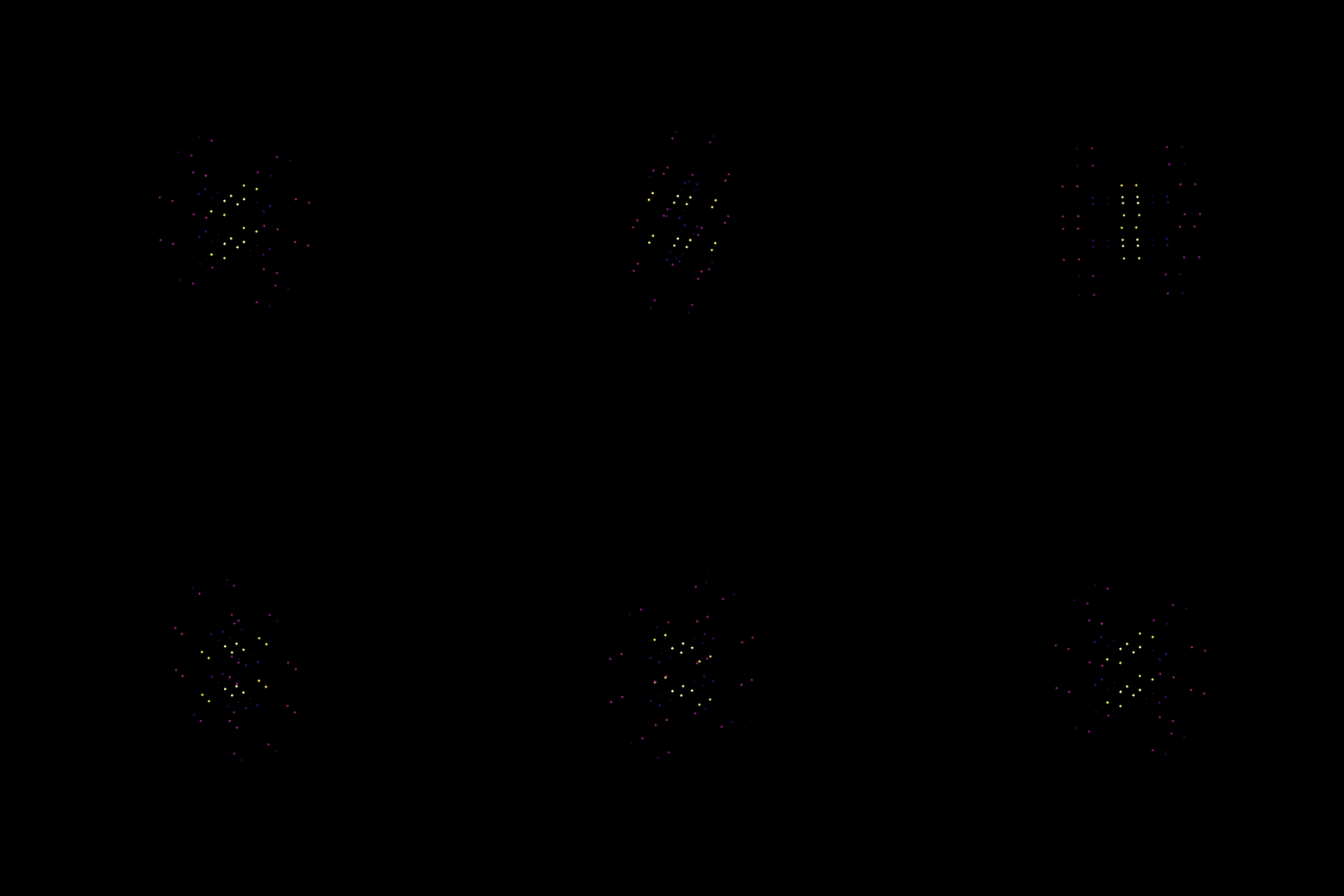
This animation visualizes admissible phase configurations under curvature and rotational constraints. It is not a literal depiction of a spinning particle or orbit, but an evolving structural coherence.
In mainstream physics, the electron is already defined by its quantum state. This article simply takes that admission seriously and extends the narrative: if state is primary, then stability is the real question; and if stability is the real question, hydrogen is the first decisive answer.